



You started strong. The meditation app was downloaded, the running shoes were by the door, the journal sat expectantly on your nightstand. Three weeks later, the app sends lonely notification reminders, the shoes have migrated to the closet, and the journal has exactly four entries—the last one apologizing for not writing more.
Sound familiar? You’re not alone. Research suggests that approximately 80% of New Year’s resolutions fail by February, and the pattern repeats throughout the year with every fresh attempt at self-improvement. But here’s what most people miss: a failed habit isn’t a character flaw or evidence that you lack willpower. It’s data. Valuable, actionable data that most people throw away along with their abandoned gym memberships.
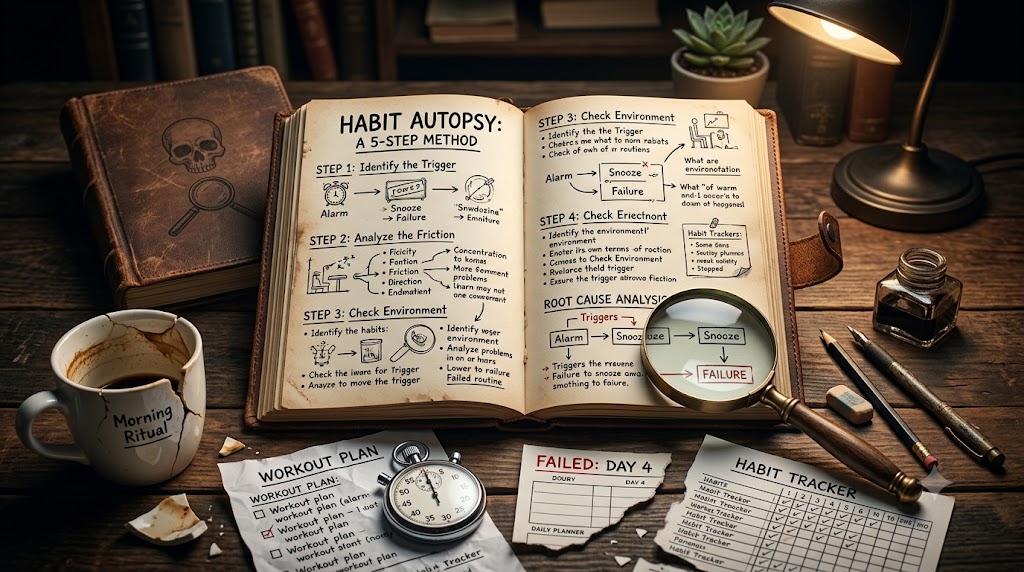
Enter the Habit Autopsy—a structured, blame-free method for dissecting failed routines to extract lessons that actually stick. Instead of cycling through the same disappointing patterns, you can transform each abandoned habit into a stepping stone toward lasting change.
What Is a Habit Autopsy (And Why It Works)
A habit autopsy borrows its name from medical practice, but instead of examining what went wrong with a body, you’re examining what went wrong with a behavior. The goal isn’t self-criticism—it’s clinical curiosity. You’re playing detective, not judge.
This approach works because it interrupts the shame spiral that typically follows failed habits. When we abandon a routine, most of us either ignore the failure entirely or beat ourselves up about it. Neither response generates useful insight. The habit autopsy creates a third path: compassionate investigation that yields actionable intelligence.
The method also acknowledges a crucial truth about behavior change: failure is not only normal, it’s necessary. Every successful habit was likely preceded by several unsuccessful attempts. The difference between people who eventually succeed and those who stay stuck isn’t the absence of failure—it’s what they do with it.
The 5-Step Habit Autopsy Method
This process works best when performed within a week of recognizing that a habit has died. Wait too long, and the details fade. Do it too soon, and you might just be having a bad day. Here’s how to conduct your autopsy:
Step 1: Establish Time of Death
When exactly did this habit stop? Not when you officially gave up, but when the cracks first appeared. Maybe you started skipping Saturdays, then weekends, then it became sporadic. Pinpointing the moment of decline often reveals the trigger. Did it coincide with a work deadline? A schedule change? A shift in seasons? Write down the approximate date and any life events happening around that time.
Step 2: Examine the Crime Scene (Your Environment)
Your environment either supports your habits or sabotages them—there’s rarely a neutral ground. Ask yourself these questions:
- Where was I supposed to perform this habit?
- What friction existed between me and the behavior?
- What competing behaviors was my environment encouraging instead?
- Were the tools or resources I needed easily accessible?
Often, you’ll discover that your environment was working against you from the start. The person who wants to eat healthier but keeps chips at eye level in the pantry is fighting an uphill battle every single day.
Step 3: Interview the Witness (Yourself)
This step requires honesty. Sit with these questions and write your answers—don’t just think them:
- What was I telling myself in the moments I skipped the habit?
- What emotions preceded the skipping?
- Was I trying to prove something to someone, or was this genuinely for me?
- On a scale of 1-10, how much did I actually want this outcome?
Sometimes the autopsy reveals that the habit was never truly yours. You were doing it because you thought you should, because someone else wanted you to, or because it seemed like what successful people do. Habits built on external motivation have a much higher mortality rate.
Step 4: Identify the Cause of Death
Based on your investigation, categorize the primary cause of death. Most habit failures fall into one of these categories:
- Too ambitious: The habit was too big, too time-consuming, or required too much energy for your current life situation.
- Poor timing: You attached it to the wrong cue or tried to perform it at a time when your willpower was depleted.
- Lack of identity alignment: The habit didn’t connect to how you see yourself or who you want to become.
- Missing reward: There was no immediate payoff, making the behavior feel like pure sacrifice.
- Environmental sabotage: Your surroundings made the wrong behavior easy and the right behavior hard.
- Life disruption: A major change broke your routine, and you never rebuilt it.
Be specific. “I got lazy” is not a cause of death—it’s an accusation. Dig deeper.
Step 5: Write the Resurrection Protocol
Now comes the actionable part. Based on your findings, write a specific plan for how this habit could be revived—or whether it should be revived at all. Your protocol should address:
- A smaller or modified version of the habit that addresses the cause of death
- Environmental changes you’ll make to reduce friction
- A new cue or time that better fits your life
- An immediate reward you’ll pair with the behavior
- A plan for what to do when you miss a day (because you will)
Common Autopsy Findings and Their Fixes
After conducting dozens of habit autopsies on yourself, patterns emerge. Here are the most common findings and their evidence-based solutions:
Finding: The habit was too vague. “Exercise more” or “read regularly” gives your brain nothing to execute. Fix: Define the behavior in terms so specific that you could explain it to a robot. “Do 10 pushups after I pour my morning coffee” leaves no room for interpretation.
Finding: You relied on motivation. Motivation is a terrible foundation for habits because it fluctuates wildly based on sleep, stress, and dozens of other factors. Fix: Design for your worst days, not your best. Make the habit so small that you can do it even when motivation is at zero.
Finding: You had no accountability. Habits practiced in isolation die in isolation. Fix: Tell someone specific what you’re doing and when. Better yet, find someone doing the same thing and check in with each other.
Finding: You broke the chain and never recovered. Missing one day often spirals into missing many. Fix: Adopt the “never miss twice” rule. Missing once is an accident; missing twice is the start of a new pattern.
Turning Autopsy Into Action
The habit autopsy only works if you actually do something with the findings. Here’s how to make sure your investigation leads to change:
Keep a habit autopsy file. Whether it’s a note on your phone or a dedicated notebook, document every autopsy you perform. Over time, you’ll spot meta-patterns—maybe all your failed habits were morning routines (hint: you might not be a morning person), or maybe they all involved activities you do alone.
Wait before restarting. After completing an autopsy, wait at least one week before attempting the habit again. This prevents you from making the same mistakes in a burst of renewed enthusiasm.
Start with 50% of what you think you can handle. Whatever habit duration or intensity you’re considering, cut it in half. You can always scale up; scaling down after starting feels like failure.
Finally, celebrate the autopsy itself. You just did something that 95% of people never do: you examined your failure with curiosity instead of shame. That meta-habit—the habit of learning from your habits—might be the most valuable routine you ever develop.
Your failed habits aren’t buried in a graveyard of good intentions. They’re in a laboratory, waiting to teach you something. The only question is whether you’re willing to look.