



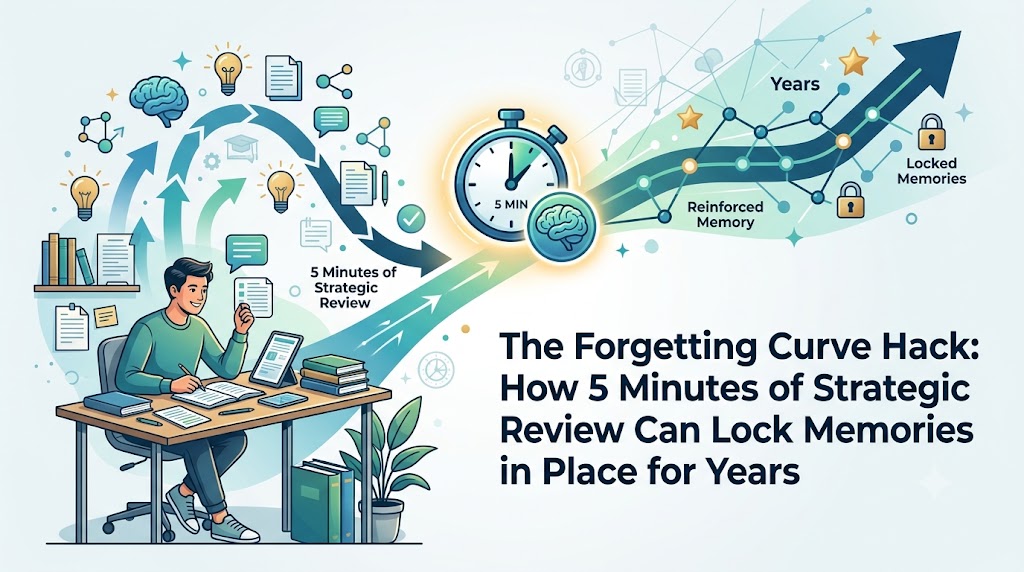
Here’s a frustrating truth about your brain: within 24 hours of learning something new, you’ll forget about 70% of it. By next week, that number climbs to nearly 90%. It’s not that you’re bad at remembering—it’s that your brain is ruthlessly efficient at dumping information it considers non-essential.
But what if you could hijack this system? What if a tiny investment of time—we’re talking five minutes or less—could dramatically extend how long you retain important information? The science suggests you absolutely can, and the technique is simpler than you might expect.
Now, I’ll admit the “5 minutes for 5 years” framing involves some poetic license. Memory is far messier than any neat formula suggests. But the underlying principle is rock-solid, backed by over a century of research. And when you understand how it works, you’ll wonder why nobody taught you this in school.
The Forgetting Curve: Your Brain’s Built-In Delete Function
In the 1880s, German psychologist Hermann Ebbinghaus conducted a series of grueling experiments on himself, memorizing thousands of nonsense syllables to map exactly how memory decays over time. His discovery—the “forgetting curve”—revealed something crucial: memory doesn’t fade gradually like a photograph left in sunlight. It plummets rapidly at first, then levels off.
Within the first hour of learning, you lose roughly half of new information. The steepest drop happens in the first 24 hours. After that, the decline slows, but by then, most of what you learned has already vanished into the cognitive void.
This isn’t a design flaw—it’s a feature. Your brain processes an astronomical amount of sensory data every second. If it retained everything with equal permanence, you’d be overwhelmed and unable to function. So your brain makes constant judgment calls: Is this worth keeping? Will I need this again?
The key insight is that these judgment calls aren’t final. You can influence them.
Spaced Repetition: The Interrupt That Changes Everything
When you revisit information at strategic intervals, something powerful happens. Each review sends a signal to your brain: “Hey, this showed up again. Maybe it’s important.” Your neural pathways respond by strengthening the connections associated with that memory.
The magic lies in the timing. Review too soon, and you’re wasting effort on something you already remember. Wait too long, and you’re essentially relearning from scratch. But hit that sweet spot—just as the memory starts to fade but before it disappears—and you trigger maximum retention with minimum effort.
This is the foundation of spaced repetition, and decades of research confirm it works across every type of learning: languages, medical facts, legal concepts, technical skills, even names and faces.
A practical spacing schedule might look like this:
- First review: 1 day after initial learning
- Second review: 3 days after the first review
- Third review: 1 week later
- Fourth review: 2-3 weeks later
- Fifth review: 1-2 months later
After five strategic touches—each taking just a few minutes—information that would have evaporated within a week can remain accessible for months or even years. The total time investment? Perhaps 20-25 minutes spread over several weeks. Compare that to hours of cramming that yields almost nothing a month later.
The 5-Minute Review Protocol
Understanding the theory is one thing. Actually implementing it is another. Here’s a streamlined protocol you can start using today:
Step 1: Capture immediately. When you encounter information worth remembering—from a meeting, book, lecture, or conversation—write down the key points within a few hours. Don’t transcribe everything. Distill it to the essential concepts, ideally in your own words. This act of summarization is itself a form of encoding.
Step 2: Set your first review. Before you close your notebook or app, schedule a specific time tomorrow to spend five minutes reviewing what you captured. Put it in your calendar. Set a phone reminder. Make it impossible to forget this step.
Step 3: Active recall, not passive reading. During your review, don’t just read your notes. Close them and try to recall the main points from memory first. Then check what you missed. This retrieval effort is where the real strengthening happens. Passive re-reading feels productive but barely moves the needle.
Step 4: Extend the intervals. After each successful review, schedule the next one at a longer interval. If you’re using a digital tool like Anki, RemNote, or even a simple spreadsheet, it can handle this scheduling automatically. If you’re analog, a simple notation system in your notebook works fine.
Step 5: Connect and elaborate. During later reviews, spend a minute linking the information to things you already know. How does this concept relate to your existing knowledge? Where might you apply it? These connections create multiple retrieval pathways, making the memory more durable and accessible.
Why This Works Better Than Cramming
Most of us learned to study through mass practice—concentrating all our effort in one or two intense sessions, usually right before we need the information. This feels effective because it produces strong short-term performance. You can absolutely ace a test tomorrow using this method.
But the forgetting curve doesn’t care about your test. It will erase that information just as ruthlessly, whether you crammed or not. The only way to beat it is to work with your brain’s natural memory consolidation process, which requires time and strategic interruption.
Think of it like building muscle. You can’t do 500 pushups in one day and expect to be fit for the next six months. Physical adaptation requires repeated stimulus with recovery periods. Memory works the same way—repeated exposure with gaps produces durable change.
Making It Stick: Practical Integration Tips
The biggest obstacle isn’t understanding spaced repetition—it’s actually doing it consistently. Here’s how to make it realistic:
- Start small. Don’t try to systematize everything you learn. Pick one domain—vocabulary for a language you’re studying, key concepts from your professional field, names of new colleagues—and build the habit there first.
- Use existing triggers. Tie your review sessions to established routines. Five minutes during your morning coffee. A quick check during your commute. Right before bed while your phone charges.
- Embrace imperfection. You won’t hit every scheduled review. That’s fine. A slightly irregular spaced repetition practice still massively outperforms no system at all.
- Focus on what matters. Not everything deserves a place in your long-term memory. Be selective. The system works best when you’re genuinely motivated to remember the material.
Your Brain Wants to Forget—Help It Remember What Matters
The forgetting curve isn’t your enemy. It’s simply your brain doing its job, filtering signal from noise. The problem is that left to its own devices, your brain often discards information you actually need.
Spaced repetition is how you take back control. Five minutes of strategic review, repeated at expanding intervals, can transform fleeting exposure into lasting knowledge. It’s not magic, and it’s not instant—but it’s remarkably close to a hack for the human memory system.
Pick something you learned today that you’d like to remember next month. Write down the key points. Set a reminder for tomorrow. And start proving to your brain that this information matters.
Five minutes. That’s all it takes to begin.