



You’ve probably had those days where you sit at your desk for eight hours straight, barely moving except to refill your coffee, yet somehow accomplish almost nothing meaningful. Meanwhile, your colleague who takes regular breaks and leaves on time consistently outperforms everyone on the team. What gives?
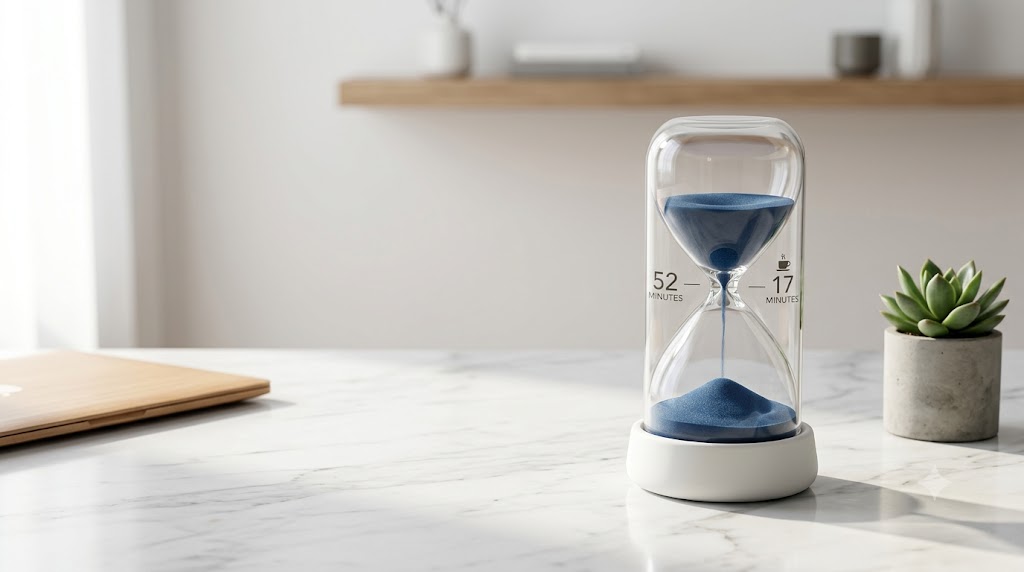
The answer might lie in a simple ratio: 52 minutes of focused work followed by 17 minutes of deliberate rest. This pattern, known as the 52-17 rule, has gained significant attention in productivity circles—and unlike many workplace trends, this one actually has research behind it. Let’s dig into what the science says and how you can apply it starting today.
Where the 52-17 Rule Actually Comes From
The 52-17 ratio originated from a study conducted by the Draugiem Group, a social networking company based in Latvia. Using a time-tracking application called DeskTime, researchers analyzed the habits of their most productive employees. The findings were striking: top performers weren’t working longer hours than their peers. Instead, they worked in focused bursts averaging 52 minutes, followed by breaks averaging 17 minutes.
What made these high performers different wasn’t superhuman focus or exceptional talent. It was their rhythm. During work periods, they committed fully to the task at hand—no email checking, no social media scrolling, no “quick” conversations with colleagues. During breaks, they stepped away completely. No half-measures on either side.
This research aligns with decades of cognitive science on attention and mental fatigue. The human brain simply isn’t designed for sustained concentration over many hours. Studies published in the journal Cognition have demonstrated that even brief diversions from a task can dramatically improve our ability to focus on that task for prolonged periods. Our attention naturally fluctuates, and working with these rhythms rather than against them yields better results.
The Science of Why Sprints Beat Marathons
Understanding why the 52-17 rule works requires a brief look at how your brain manages energy and attention. Neuroscience research has established that focused attention is a limited resource that depletes with use—a phenomenon researchers call “ego depletion” or cognitive fatigue.
A landmark study by psychologist Alejandro Lleras at the University of Illinois found that prolonged attention to a single task actually hinders performance. His research, published in Cognition in 2011, showed that brief breaks during long tasks help maintain consistent performance levels. “Deactivating and reactivating your goals allows you to stay focused,” Lleras explained in discussing the findings.
There’s also the matter of ultradian rhythms—natural cycles in our body that affect alertness and energy throughout the day. Research by sleep scientist Nathaniel Kleitman, who discovered REM sleep, found that our bodies operate on roughly 90-120 minute cycles of higher and lower alertness. Working in focused sprints respects these natural rhythms rather than fighting against them.
When you push through fatigue without breaks, you’re not demonstrating dedication—you’re actually making more errors, thinking less creatively, and setting yourself up for burnout. The research consistently shows that strategic rest isn’t the opposite of productivity; it’s a crucial component of it.
What Counts as a Real Break (Hint: Not Scrolling Your Phone)
Here’s where many people go wrong with the 52-17 rule: they treat break time as screen-switching time. Closing your work laptop to open Instagram isn’t giving your brain the rest it needs. Research from the University of California, Irvine has shown that it takes an average of 23 minutes to fully regain focus after an interruption. Digital distractions during breaks can actually make returning to work harder.
Effective breaks share certain characteristics. They involve physical movement, even if it’s just a short walk. They give your eyes a rest from screens. They allow your mind to wander without demanding focused attention. Here’s what actually works:
- Take a walk outside, even for just five minutes. Exposure to natural light helps regulate your circadian rhythm and boosts alertness.
- Do simple stretches at your desk or in a quiet space. Physical movement increases blood flow to the brain.
- Have a genuine conversation with a colleague—not about work, but about anything else.
- Practice a brief mindfulness exercise or simply sit quietly with your eyes closed.
- Get a healthy snack or hydrate properly. Your brain consumes about 20% of your daily calories, and dehydration impairs cognitive function quickly.
The key is complete mental disengagement from work tasks. Your brain needs this downtime to consolidate information and prepare for the next focused session.
How to Actually Implement This Without Your Boss Raising Eyebrows
Let’s be realistic: not every workplace will embrace the idea of employees taking 17-minute breaks every hour. However, you can adapt the core principle to your situation. The specific numbers 52 and 17 aren’t magic—they’re averages from one study. What matters is the underlying pattern of focused work followed by genuine rest.
Start by blocking your calendar for focused work sessions. Treat these blocks as non-negotiable appointments with yourself. Turn off notifications during these periods. Close unnecessary browser tabs. Put your phone in a drawer or another room.
If taking a 17-minute break every hour isn’t feasible in your workplace, try a modified approach. Work in 90-minute blocks with 15-20 minute breaks. Or use the classic Pomodoro Technique as a stepping stone: 25 minutes of work with 5-minute breaks, taking a longer break after four cycles. The principle remains the same.
Track your results for two weeks. Note your energy levels, the quality of your output, and how you feel at the end of each workday. Most people who commit to this experiment find they accomplish more in fewer hours—and arrive home with energy left over for their actual lives.
Making Sprint-Based Work Your Default Mode
Shifting from marathon work sessions to strategic sprints requires some initial discipline, but it quickly becomes self-reinforcing. When you experience the difference in both productivity and well-being, you won’t want to go back to grinding through eight-hour slogs.
Start tomorrow with a single focused sprint. Set a timer for 52 minutes (or whatever duration feels sustainable for you). Work on one important task without interruption. When the timer sounds, step away completely for 15-17 minutes. Notice how you feel when you return to work.
The most productive people have figured out something that seems counterintuitive: rest isn’t the enemy of accomplishment. It’s the foundation of sustainable high performance. Your brain evolved for bursts of focused activity followed by recovery periods. Working with your biology instead of against it isn’t lazy—it’s smart.
Stop wearing exhaustion as a badge of honor. Start working in sprints. Your productivity—and your quality of life—will thank you.