



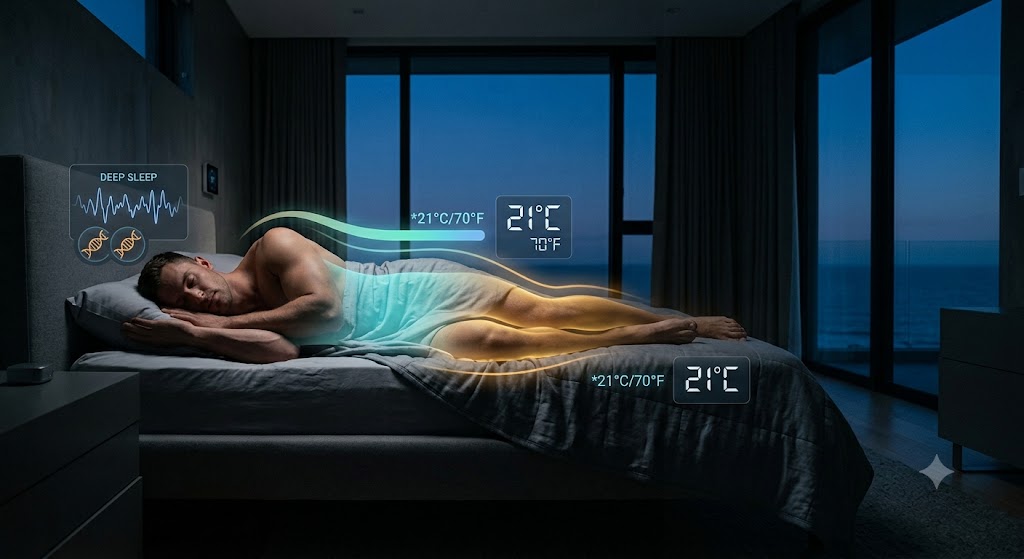
You’ve been crushing your workouts, hitting your protein targets, and staying consistent with your training program. Yet somehow, your gains aren’t coming as fast as you’d hoped. Here’s a question that might never have crossed your mind: What temperature is your bedroom?
It turns out that the thermal environment where you spend roughly one-third of your life plays a surprisingly significant role in muscle recovery and growth. Scientists have identified a temperature sweet spot that optimizes the hormonal cascade responsible for repairing and building muscle tissue while you sleep. Let’s dive into what the research actually says—and how you can use this knowledge to maximize your results.
The Science Behind Sleep Temperature and Muscle Growth
Your body doesn’t build muscle in the gym—it builds muscle while you recover, primarily during sleep. This process depends heavily on growth hormone (GH), which is released in pulses throughout the night, with the largest surge occurring during deep slow-wave sleep.
Research published in the journal Sleep has demonstrated that sleep quality and duration directly impact growth hormone secretion. A study by Van Cauter et al. (1997) found that sleep deprivation can reduce growth hormone release by as much as 70%. But here’s where temperature enters the equation: your body needs to drop its core temperature by approximately 1-2°F (0.5-1°C) to initiate and maintain quality sleep, according to research from the Division of Sleep Medicine at Harvard Medical School.
The National Sleep Foundation, along with multiple peer-reviewed studies, suggests that the optimal bedroom temperature for quality sleep falls between 60-67°F (15.5-19.4°C), with many sleep researchers pointing to 65°F (18.3°C) as the ideal target. A 2012 study published in the Journal of Physiological Anthropology found that thermal environment significantly affects sleep stages, with cooler temperatures promoting more time in restorative deep sleep—exactly when growth hormone release peaks.
How Cool Temperatures Trigger Your Body’s Recovery Mode
When you fall asleep in a cooler environment, you’re essentially giving your body permission to do what it naturally wants to do: cool down. Your circadian rhythm is intimately connected to your thermoregulation system. As evening approaches, your core body temperature begins to decline, signaling to your brain that it’s time to sleep.
A bedroom that’s too warm interferes with this process. Research published in Science Advances (Obradovich et al., 2017) analyzed sleep data and found that abnormal nighttime temperatures significantly disrupted sleep patterns. When your body struggles to shed heat, you spend more time in lighter sleep stages and less time in the deep, restorative phases where the magic of muscle recovery happens.
During deep sleep, blood flow to your muscles increases, tissue repair accelerates, and protein synthesis ramps up. A study in the Journal of Clinical Endocrinology & Metabolism confirmed that the majority of daily growth hormone secretion occurs during sleep, particularly during the first half of the night when deep sleep is most prevalent. Creating the right thermal environment helps ensure you’re not shortchanging this critical window.
Testosterone, Sleep Quality, and the Temperature Connection
Growth hormone isn’t the only anabolic hormone affected by your sleep environment. Testosterone, which plays a crucial role in muscle protein synthesis for both men and women, is also highly sleep-dependent.
Research published in JAMA (Leproult & Van Cauter, 2011) demonstrated that restricting sleep to five hours per night for one week reduced testosterone levels by 10-15% in young healthy men. While this study focused on sleep duration, subsequent research has shown that sleep quality—which is directly influenced by temperature—affects testosterone production during sleep.
The testicles, where testosterone is primarily produced in men, function optimally at temperatures slightly below core body temperature. While the relationship between ambient room temperature and testicular temperature during sleep hasn’t been extensively studied, maintaining a cooler sleep environment supports overall thermoregulation and sleep quality, indirectly supporting healthy testosterone levels.
Practical Steps to Optimize Your Sleep Temperature Tonight
Understanding the science is one thing; implementing it is another. Here are evidence-based strategies to dial in your sleep environment for better recovery:
- Set your thermostat to 65°F (18.3°C) as a starting point. Individual preferences vary, so experiment within the 60-67°F range to find your personal sweet spot.
- Choose breathable bedding materials. Cotton, bamboo, or moisture-wicking athletic fabrics help regulate temperature throughout the night better than synthetic materials that trap heat.
- Take a warm shower 1-2 hours before bed. Counterintuitively, this helps lower your core temperature. Research in Sleep Medicine Reviews (Haghayegh et al., 2019) found that a warm bath or shower before bed improved sleep quality by facilitating the natural temperature drop.
- Keep your feet uncovered if you tend to overheat. Your extremities are highly vascularized and serve as natural radiators for releasing excess body heat.
- Consider your sleepwear carefully. Lightweight, loose-fitting clothes or sleeping without clothes allows for better thermoregulation than heavy pajamas.
- Limit alcohol before bed. While alcohol might make you feel sleepy, it disrupts temperature regulation and reduces time spent in deep sleep, according to research in Alcoholism: Clinical and Experimental Research.
The Bigger Picture: Sleep as a Performance Enhancer
Elite athletes have long recognized sleep as a legal performance-enhancing tool. A landmark study by Mah et al. (2011) published in Sleep found that when Stanford basketball players extended their sleep to 10 hours per night, their sprint times improved, shooting accuracy increased, and reaction times quickened.
Temperature optimization is just one piece of the sleep hygiene puzzle, but it’s an often-overlooked variable that’s completely within your control. Unlike supplements with questionable efficacy or complicated training periodization schemes, adjusting your thermostat costs nothing and requires zero additional time.
The evidence is clear: quality sleep in an appropriately cool environment supports the hormonal processes that drive muscle recovery and growth. You’re already investing hours in training and careful attention to nutrition. It would be a shame to undermine those efforts by neglecting the environment where your body actually does the building.
Tonight, before you go to bed, check your thermostat. That simple action might be the easiest gain you’ll ever make.