



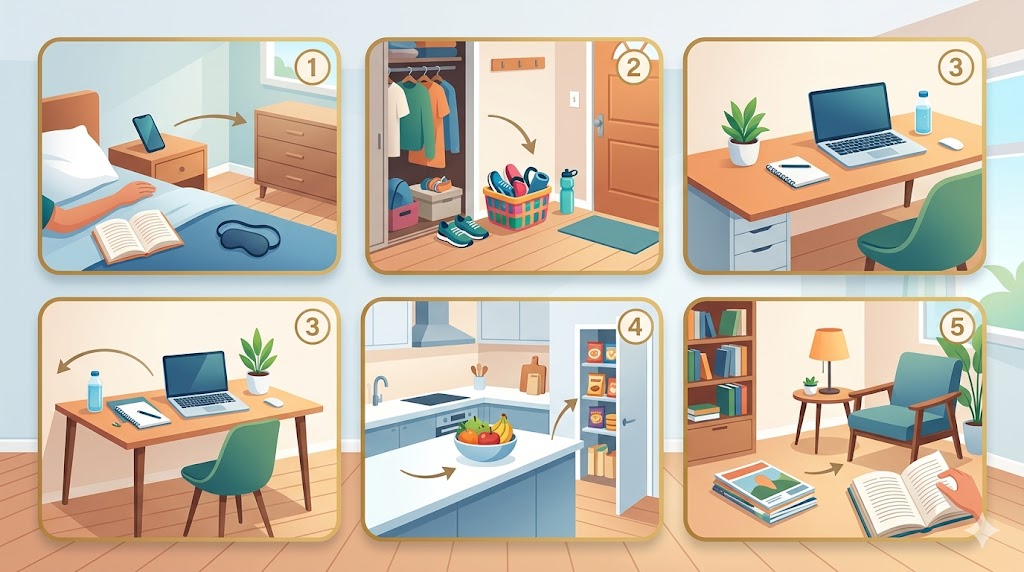
What if the secret to building better habits wasn’t about willpower at all? What if it was simply about moving your fruit bowl six inches to the left?
This isn’t some oversimplified life hack—it’s the science of environmental design, and it’s revolutionizing how behavioral psychologists think about habit formation. The truth is, we like to believe we’re rational creatures making conscious decisions throughout the day. But research suggests that up to 45% of our daily behaviors are habitual, triggered not by deliberate choice but by the cues surrounding us.
The good news? You can hack this system. By strategically repositioning just five objects in your living space, you can create an environment that makes good habits effortless and bad habits inconvenient. No motivation required. No white-knuckle discipline. Just smart design.
The Science Behind Environmental Editing
Behavioral scientist BJ Fogg, founder of Stanford’s Behavior Design Lab, has spent decades studying why people do what they do. His conclusion is surprisingly simple: behavior happens when motivation, ability, and a prompt converge at the same moment. Remove any one of these elements, and the behavior doesn’t occur.
Environmental editing works primarily on two of these factors: ability and prompts. When you place your running shoes by the door, you’re both creating a visual prompt and reducing the friction (increasing ability) to exercise. When you hide your TV remote in a drawer, you’re removing the prompt and adding friction to mindless watching.
The beauty of this approach is that it works even when your motivation is low—which, let’s be honest, is most of the time. You don’t need to feel inspired to drink more water if a full glass is already sitting on your desk. The environment does the heavy lifting for you.
Object #1: Your Water Bottle (Or Any Hydration Vessel)
Let’s start with the simplest change that yields the most consistent results. Move a filled water bottle or glass to wherever you spend the most time—your desk, your nightstand, or your kitchen counter.
The key here is visibility and accessibility. A water bottle buried in your bag might as well not exist. But a clear glass of water in your direct line of sight becomes an automatic prompt to drink. Studies show that people consume significantly more water when it’s within arm’s reach versus when they need to get up to retrieve it.
If you don’t use a water bottle, any beverage container works. The point is making hydration the path of least resistance. Some people find success with a large pitcher they refill each morning, creating both a visual cue and a tangible daily goal. Others prefer a marked bottle that tracks intake throughout the day. Experiment with what fits your lifestyle.
Object #2: Your Phone Charger (The Digital Boundary Setter)
Here’s a change that sounds minor but produces dramatic results: move your phone charger to a location outside your bedroom. If that’s not possible, at minimum place it across the room rather than on your nightstand.
This single adjustment accomplishes multiple goals simultaneously. It eliminates the temptation to scroll before sleep, improves your sleep quality by reducing blue light exposure, and forces you to physically get up when your alarm sounds—making it nearly impossible to hit snooze repeatedly.
For those who use their phone as an alarm and genuinely need it nearby, consider purchasing an inexpensive alarm clock and banishing the phone entirely. Alternatively, place the charger at the farthest point in your bedroom that still allows you to hear the alarm. The extra steps between you and your phone create just enough friction to break the autopilot scrolling habit.
If you work from home and struggle with phone distractions during work hours, apply the same principle to your workspace. Charge your phone in another room entirely during focus periods.
Object #3: Your Default Snack (The Kitchen Swap)
Take whatever healthy snack you wish you ate more of—fruit, nuts, cut vegetables—and swap its location with whatever tempting snack you wish you ate less of. Put the healthy option at eye level, in the front of the refrigerator or pantry, or better yet, on the counter in plain sight.
Research from Cornell University’s Food and Brand Lab found that people are three times more likely to eat the first food they see in a cupboard than the fifth. Simply rearranging the order of foods in your kitchen can significantly shift your eating patterns without requiring any restriction or deprivation.
This tip adapts easily to different situations. If you don’t keep snacks at home, apply this principle to your workspace or wherever impulsive eating tends to happen. If you live with others who purchase snacks you’d rather avoid, designate a specific cabinet or drawer as theirs and simply stop opening it. Out of sight genuinely means out of mind when it comes to food cues.
Object #4: A Book (Analog Entertainment Upgrade)
Place a book—something you actually want to read—in the exact spot where you typically reach for your phone or remote control. This might be your couch cushion, your bed pillow, your breakfast table, or your bathroom counter.
The goal isn’t to force yourself to read more through sheer determination. It’s to make reading the default option when you’re looking for entertainment or mental stimulation. When both a book and your phone are equidistant, you’ll still sometimes choose the phone. But you’ll choose the book far more often than when it was sitting on a shelf across the room.
If you’re not a book person, substitute any analog activity you’d like to cultivate: a journal, a sketchpad, a crossword puzzle book, or even a musical instrument if space permits. The underlying principle remains the same—position the desired activity directly in the path of least resistance.
Object #5: Your Exercise Equipment (Or Active Trigger)
Take one piece of exercise equipment—a yoga mat, a resistance band, a pair of dumbbells, or simply your workout clothes—and place it somewhere impossible to ignore. This might mean your yoga mat stays permanently unrolled in the living room, your running shoes block the door, or your gym bag sits on the passenger seat of your car.
The visual presence of exercise equipment serves as a constant gentle reminder without being a nagging one. It also eliminates one of the most common barriers to working out: the setup time. When your mat is already out, starting a quick stretching session requires zero preparation.
If you don’t own exercise equipment, your workout clothes can serve the same function. Lay them out the night before in a spot you can’t miss. Some people even sleep in their workout gear to eliminate every possible barrier between waking up and moving their body.
For apartment dwellers with limited space, a resistance band hooked over a door handle or a jump rope hanging from a hook can provide the same visual prompt without cluttering your living area.
Making Environmental Editing Stick
Start with just one or two of these changes rather than overhauling your entire home at once. Give each adjustment at least two weeks before evaluating its effectiveness—habits take time to form, even when the environment supports them.
Pay attention to your actual behavior patterns before deciding what to move. Spend a few days noticing where you naturally gravitate, what you reach for without thinking, and where your friction points exist. Your ideal object placements might differ from the examples above based on your unique living situation and daily routines.
Remember that environmental editing isn’t about perfection. Some days you’ll still choose the chips over the apple, scroll your phone in bed, or step over your yoga mat on the way to the couch. The goal is shifting your default behaviors over time, not controlling every single choice. Small shifts in your environment create small shifts in your behavior, which compound into significant changes over months and years.
Your home is already shaping your habits—whether you’ve designed it intentionally or not. By repositioning just these five objects, you reclaim that influence and point it toward the person you want to become.