



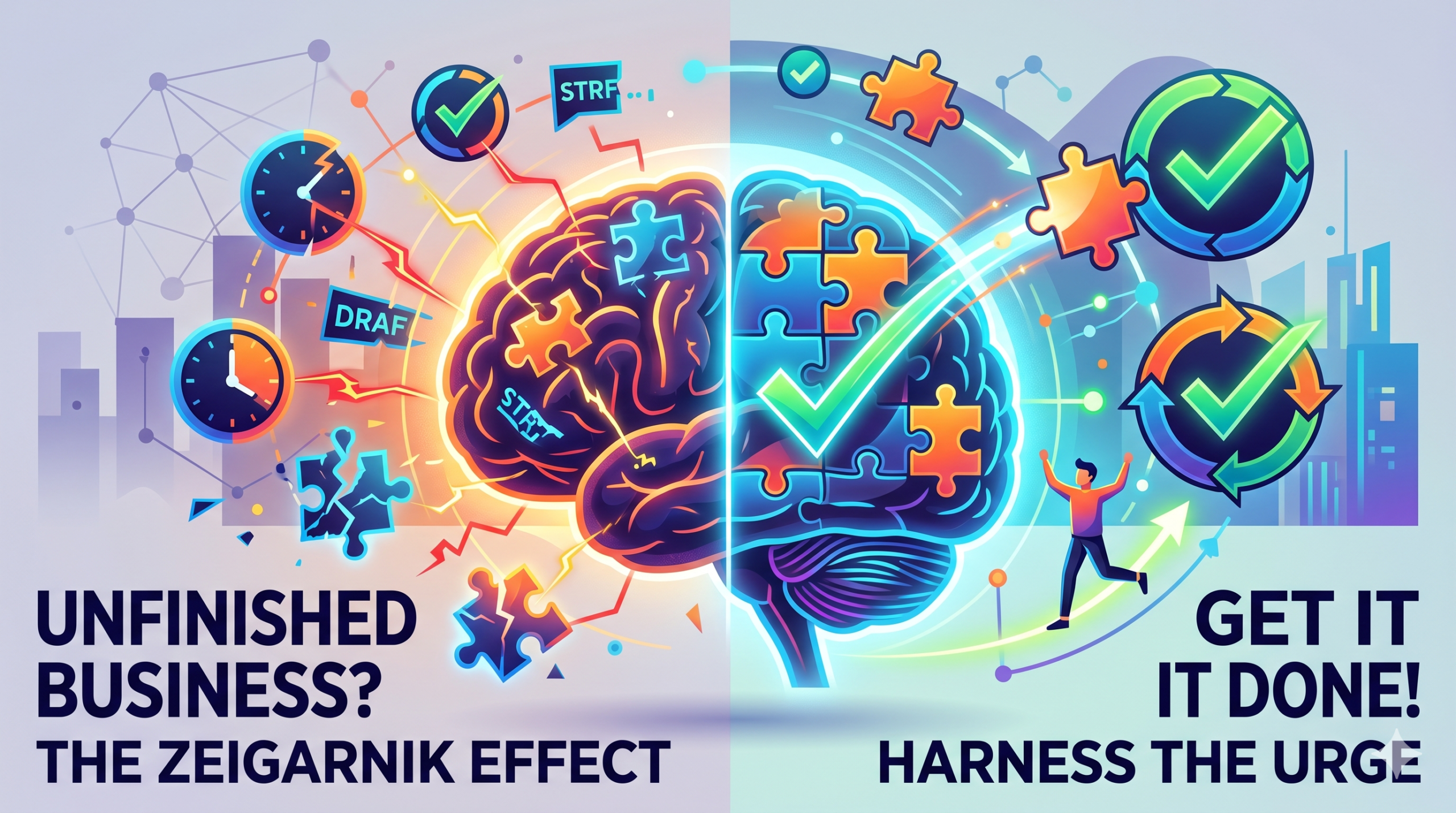
You know that nagging feeling when you leave a task half-done? The way an unfinished email haunts you during dinner, or how an abandoned project keeps popping into your mind at 2 AM? That’s not a character flaw—it’s your brain doing exactly what it’s designed to do. And once you understand why this happens, you can actually harness it to become dramatically more productive.
Welcome to the fascinating world of the Zeigarnik Effect, a psychological phenomenon that explains why incomplete tasks occupy more mental real estate than finished ones. For some of us—especially those with ADHD tendencies—this effect can feel like both a curse and a superpower. Let’s explore how to make it work in your favor.
What Exactly Is the Zeigarnik Effect?
In the 1920s, Soviet psychologist Bluma Zeigarnik noticed something curious while sitting in a busy Viennese restaurant. The waiters could remember complex, unpaid orders with remarkable accuracy—but the moment a bill was settled, that information seemed to vanish from their minds. Intrigued, she conducted experiments that confirmed her observation: our brains hold onto unfinished tasks with surprising tenacity while quickly discarding completed ones.
This happens because your brain treats incomplete tasks as “open loops.” Like a computer running background programs, these unfinished items consume mental bandwidth even when you’re not actively thinking about them. Your mind keeps circling back, essentially nagging you: “Hey, don’t forget about this. We’re not done here.”
From an evolutionary perspective, this makes perfect sense. Our ancestors needed to remember where they’d hidden food or which tool they were crafting. The brain developed a built-in reminder system to ensure survival-critical tasks didn’t slip through the cracks. Today, that same mechanism fires whether you’re tracking a predator or just trying to remember to respond to your aunt’s birthday text.
When the Effect Backfires: The ADHD Connection
Here’s where things get complicated. For individuals with ADHD or ADHD-like tendencies, the Zeigarnik Effect can become overwhelming rather than helpful. Instead of one or two open loops gently reminding you to finish something, you might have dozens—or hundreds—competing for attention simultaneously.
The ADHD brain often struggles with working memory and task prioritization. This means those “background programs” don’t run quietly; they crash into each other, creating mental chaos. You might feel paralyzed by the sheer volume of incomplete tasks, or you might hyperfocus on closing one loop while dozens of others grow more urgent. The very mechanism designed to help you finish things can actually prevent you from finishing anything.
If this resonates with you, know that you’re not lazy or broken. Your brain is simply running an amplified version of a universal human experience. The good news? Understanding this gives you specific leverage points for intervention.
Strategic Incompletion: Using Open Loops Intentionally
Now let’s flip the script. Instead of being victimized by incomplete tasks, what if you deliberately created strategic open loops to boost your productivity?
Ernest Hemingway famously stopped writing mid-sentence each day. This wasn’t laziness—it was psychological engineering. By leaving his work deliberately incomplete, he ensured his brain would keep processing the story overnight. The next morning, he could sit down and immediately continue because the task was already “loaded” in his mental workspace.
You can apply this same principle to your own work:
- Stop mid-task, not between tasks. Ending your workday in the middle of something creates natural momentum for tomorrow. Your brain will keep the context warm overnight.
- Leave breadcrumbs for yourself. When pausing a project, write a quick note about exactly where you stopped and what the next small step is. This reduces the activation energy needed to restart.
- Use physical cues. Leave your workspace “mid-action”—a document open, materials laid out, a sticky note with your next action. Visual incompletion triggers the Zeigarnik Effect on sight.
The Closure Protocol: Protecting Your Mental Bandwidth
Strategic incompletion only works if you’re also strategic about completion. Without intentional closure practices, you’ll drown in open loops. Here’s how to close them effectively:
- Create a “brain dump” ritual. Spend five minutes each morning or evening writing down every incomplete task occupying your mind. Getting them out of your head and onto paper literally closes the mental loop—your brain relaxes once it trusts the information is captured externally.
- Batch your closures. Designate specific times for clearing small, nagging tasks. A 30-minute “completion sprint” where you respond to emails, make quick calls, and handle administrative items can close dozens of loops at once.
- Declare tasks officially abandoned. Sometimes the healthiest thing you can do is consciously decide not to finish something. Write it down, acknowledge you’re letting it go, and give your brain permission to release it. An intentionally abandoned task creates far less mental drag than one in eternal limbo.
- Celebrate completions visibly. Cross items off physical lists. Move tasks to a “Done” column. Create a ritual that signals to your brain: “This loop is closed.” The satisfaction reinforces the completion and helps clear mental space.
Building Your Personal System
For those with ADHD tendencies, generic productivity advice often falls flat because it doesn’t account for how differently your brain processes open loops. Here’s a more intensive framework designed specifically for minds that run hot:
Externalize everything. Your working memory is already overloaded. Use physical systems—notebooks, apps, whiteboards—as external hard drives for your brain. The goal is zero open loops held only in your head.
Limit active projects ruthlessly. You might have a hundred things you could do, but actively working on more than three to five projects creates unsustainable mental load. Put the rest in a “someday/maybe” list and give yourself permission to ignore it.
Use commitment devices. Tell someone your deadline. Pay for a class in advance. Create external accountability that makes the open loop harder to ignore. When internal motivation fluctuates, external structures keep you anchored.
Design for re-entry. Every time you pause a task, spend 60 seconds making it embarrassingly easy to resume. Write the next sentence. Set up the next tool. Remove every possible barrier between future-you and continuation.
Turning Mental Tension Into Momentum
The Zeigarnik Effect isn’t something to overcome—it’s something to orchestrate. Your brain’s craving for completion is a feature, not a bug. The key is becoming the conductor rather than being carried along by the chaos.
Start small. Today, try leaving one important task strategically incomplete when you finish working. Write down exactly where you stopped and what comes next. Tomorrow, notice how much easier it is to dive back in. That’s the Zeigarnik Effect working for you instead of against you.
For those who struggle with an overactive version of this phenomenon, remember: the goal isn’t to have zero open loops. It’s to have the right loops open at the right times, while maintaining systems that prevent the rest from consuming your mental energy. With practice, you can transform that restless craving for completion from a source of anxiety into your most reliable engine for getting things done.